











March 4, 2026The Union Budget 2026 introduces several important tax reforms aimed at simplifying the tax system, improving compliance, and enhancing transparency in the financial ecosystem.
For businesses, professionals, and investors, these changes may have a significant impact on tax planning, reporting, and compliance requirements from the upcoming financial year.
One of the most important announcements is the introduction of the new Income Tax Act 2025, which will come into effect from 1 April 2026. This reform aims to modernize and simplify the tax framework that has been in place for decades.
Below are the five major tax changes every business owner should understand.
1. New Income Tax Act from April 2026
One of the most significant reforms announced in the budget is the implementation of the new Income Tax Act 2025 starting from 1 April 2026.
The current Income Tax Act of 1961 has been amended hundreds of times over the years, making it complex and difficult to interpret. The new law aims to simplify provisions and improve clarity.
Key Highlights
• Simplified structure of tax provisions
• Removal of outdated and redundant sections
• More clarity in definitions and compliance requirements
• Easier interpretation for taxpayers and professionals
• Digitally aligned tax framework for modern reporting
Impact on Businesses
Businesses will benefit from clearer tax provisions, reduced ambiguity, and better compliance efficiency. Tax planning and reporting are expected to become more streamlined under the new structure.
2. Simplified ITR Forms
Another major step towards ease of compliance is the simplification of Income Tax Return (ITR) forms.
Many taxpayers and businesses currently face challenges due to complex filing requirements and multiple reporting schedules. The government aims to simplify these forms to make tax filing easier and faster.
Key Highlights
• Simplified return formats
• Reduced number of reporting fields
• Better integration with digital systems
• Faster processing of tax returns
• Improved user experience on the income tax portal
Impact on Taxpayers
Simplified forms will help small businesses, professionals, and individual taxpayers file returns with fewer errors and less time.
3. Foreign Asset Disclosure Scheme
The government has introduced a Foreign Asset Disclosure Scheme aimed at improving transparency and compliance in overseas financial holdings.
Many taxpayers hold foreign bank accounts, investments, or assets, and proper disclosure of these assets is mandatory under Indian tax laws.
Key Highlights
• One-time disclosure opportunity for foreign assets
• Encouragement for voluntary compliance
• Reduction of penalties for timely disclosure
• Stronger monitoring of international financial assets
Impact on Taxpayers
This initiative provides an opportunity for taxpayers to regularize foreign assets while avoiding severe penalties and legal complications in the future.
4. STT (Securities Transaction Tax) Rates Revised
The budget also proposes changes to Securities Transaction Tax (STT) applicable to stock market transactions.
STT is charged on transactions related to equity shares, derivatives, and other securities traded on recognized stock exchanges.
Key Highlights
• Revision in STT rates on certain securities transactions
• Impact on derivatives and equity trading
• Alignment with evolving financial markets
• Improved tax efficiency in capital markets
Impact on Investors
Traders and investors may see changes in transaction costs, especially in derivatives trading. It is important for market participants to evaluate how these changes affect their investment strategies and profitability.
5. Easier Compliance Rules for Businesses
Another important focus of Budget 2026 is reducing compliance burden for businesses.
The government has introduced measures aimed at making regulatory compliance simpler and more efficient.
Key Highlights
• Simplified compliance procedures
• Reduced penalties for minor defaults
• Increased use of digital compliance systems
• Faster dispute resolution mechanisms
• Improved ease of doing business
Impact on Businesses
These reforms aim to reduce administrative burden and encourage voluntary compliance, allowing businesses to focus more on growth and operations rather than complex regulatory processes.
Why These Changes Matter for Businesses
The reforms introduced in Union Budget 2026 reflect the government’s broader vision of:
• Simplifying the tax structure
• Increasing transparency in financial reporting
• Promoting voluntary compliance
• Strengthening India’s financial ecosystem
• Improving the ease of doing business
For business owners, staying informed about these developments is essential for effective tax planning and compliance management.
What Businesses Should Do Now
To prepare for these changes, businesses should:
✔ Review their current tax structures
✔ Ensure accurate financial reporting and documentation
✔ Evaluate the impact of new compliance requirements
✔ Plan investments considering the revised STT rates
✔ Consult tax professionals for strategic tax planning
Early preparation can help businesses avoid last-minute compliance challenges and take advantage of potential benefits under the new system.
Conclusion
The Union Budget 2026 tax reforms represent a major step toward creating a simpler, transparent, and more efficient tax framework in India.
With the introduction of the new Income Tax Act, simplified ITR forms, revised STT rates, and improved compliance procedures, both businesses and taxpayers can expect a more streamlined tax environment in the coming years.
Staying informed and preparing early will help businesses adapt smoothly to the upcoming tax reforms and maintain full compliance with evolving regulations.
Read more...
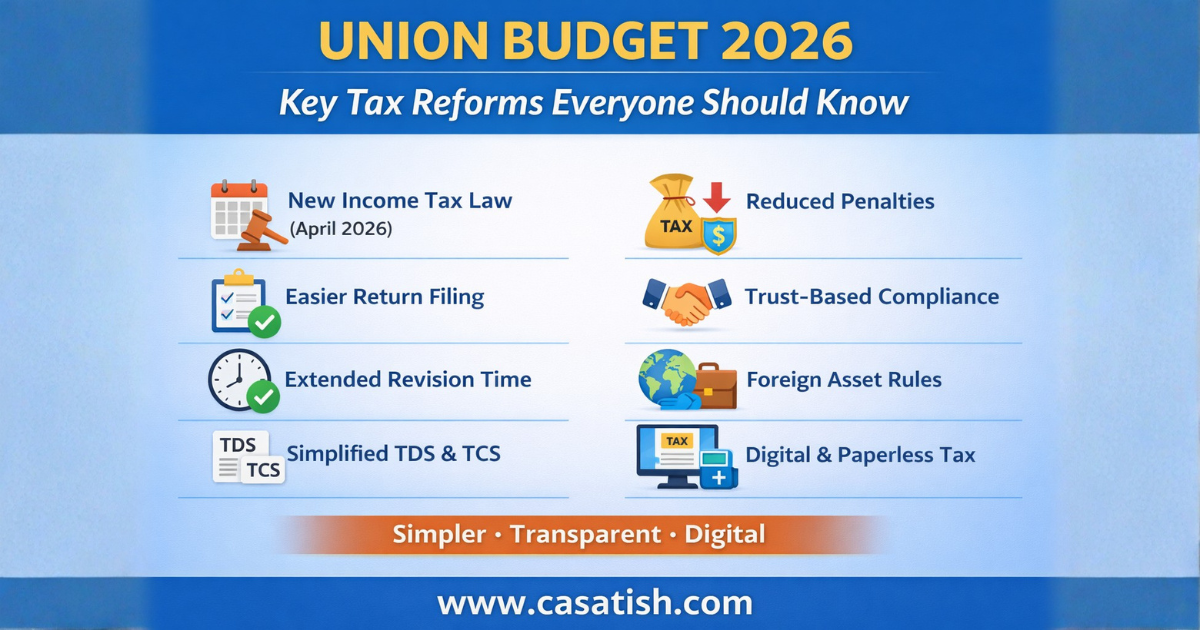
February 2, 2026The Union Budget 2026 introduces a series of reforms aimed at making taxation simpler, compliance easier,
and the overall system more transparent. The focus is on reducing complexity, encouraging voluntary compliance,
and using technology to improve efficiency. Below is a clear overview of the most important reforms that affect
individuals, businesses, and investors.
1. New Income-Tax Law from April 2026
A new income-tax law will come into effect from 1 April 2026. While tax rates remain largely stable, the structure
of the law has been rewritten in simpler language with clearer provisions. The goal is to remove outdated sections,
reduce confusion, and make tax rules easier to understand.
What this means:
Taxpayers can expect better clarity, fewer disputes, and more predictable outcomes.
2. Easier Income-Tax Return Filing
Income-tax return forms are being simplified with fewer complicated schedules and more pre-filled information.
The process is designed to reduce errors and make filing more user-friendly.
What this means:
Filing returns becomes quicker and less stressful, especially for individuals and small businesses.
3. More Time to Correct Mistakes
The time limit for revising income-tax returns has been extended. This allows taxpayers to correct genuine mistakes
or omissions without immediately facing penalties.
What this means:
Greater flexibility and peace of mind when filing returns.
4. Simplified TDS and TCS Rules
The Budget rationalises tax deduction and collection provisions to reduce unnecessary deductions and improve cash flow.
Thresholds and procedures have been streamlined.
What this means:
Less money gets blocked due to excess deductions and compliance becomes smoother.
5. Reduced Penalties and Litigation
The government is moving towards fewer penalties and less litigation. In many cases, monetary adjustments will replace
harsh penalties, and multiple proceedings for the same issue will be avoided.
What this means:
Faster resolution of tax matters and lower legal burden.
6. Shift to Trust-Based Compliance
Minor and technical defaults are being treated with a more lenient approach. The focus is on encouraging honest reporting
rather than punishment for small mistakes.
What this means:
A friendlier tax environment that rewards voluntary compliance.
7. Fully Digital Tax Processes
Tax administration will continue to move towards paperless and faceless systems. Certificates, approvals,
and communications will be issued digitally.
What this means:
Less paperwork, fewer physical visits, and faster processing.
8. Clearer Rules for Foreign Assets and Income
Reporting requirements for foreign assets and overseas income have been simplified and clarified. Taxpayers are given
better guidance and opportunities to regularise disclosures.
What this means:
Improved certainty for people with international income or investments.
9. Stronger Reporting for Property and Digital Assets
Transactions involving immovable property and digital assets such as virtual currencies will have stricter reporting norms.
The system will rely more on data matching and automated checks.
What this means:
Accurate reporting becomes more important to avoid notices or mismatches.
10. Changes Affecting Investors and Businesses
Updates related to securities transactions, share buybacks, and corporate taxation will influence financial planning
and reporting. These changes encourage transparency and long-term compliance.
What this means:
Investors and businesses should review their tax strategies carefully.
11. Technology-Driven Tax System
The Budget reinforces the use of technology, automation, and data analytics to improve efficiency and transparency
in the tax system.
What this means:
Faster processing, fewer errors, and improved trust in the system.
Final Takeaway
Union Budget 2026 focuses on:
Simpler tax laws
Easier compliance
Reduced penalties and disputes
Greater use of digital systems
A trust-based approach to taxation
These reforms aim to make the tax system more transparent, predictable, and taxpayer-friendly in the long run.
Read more...

November 1, 2025The Securities and Exchange Board of India (SEBI) has recently introduced a new set of regulations to make the Indian derivatives market more transparent, stable, and investor friendly. One of the most affected segments is Nifty Bank, an index that tracks the performance of major banking stocks listed on the NSE.
These changes are designed to control speculation, balance risk, and ensure that derivative products remain aligned with their underlying market value. Let’s understand what has changed and how it impacts traders, investors, and the broader market.
1. Higher Minimum Contract Value
SEBI has revised the minimum contract value for index derivatives, which includes indices like Nifty Bank. The notional value of a single derivative contract must now fall within a prescribed range (usually ₹15–₹20 lakh).
What This Means:
The lot size of Nifty Bank futures and options will be adjusted to meet the new contract value range.
Traders will require a higher margin or capital to take positions.
The move aims to discourage excessive speculative trading and encourage more stable participation.
2. Position and Quantity Limits
To curb market manipulation and concentration risk, SEBI has revised the quantity freeze limits and imposed stricter position limits for traders and institutions.
Key Takeaways:
Traders cannot take excessively large positions in index derivatives.
Exchanges will automatically freeze orders that exceed the specified quantity limit.
This helps reduce volatility and ensures orderly trading.
3. Changes in Weekly Options and Expiry Days
SEBI has also decided to regulate the availability of weekly options contracts. Under the new rule, each exchange can offer weekly expiries for only one benchmark index.
Impact on Nifty Bank:
Either Nifty 50 or Nifty Bank will have weekly expiries on a given exchange, not both.
The goal is to reduce excessive speculation in shortterm options.
Traders will have fewer expiryday contracts but with potentially more liquidity in the ones that remain.
4. Restructuring of Nifty Bank Index Composition
SEBI has proposed diversification within major indices such as Nifty Bank to prevent overreliance on a few largecap banks.
Changes Expected:
The weight of the largest banks in the index will be capped.
More banks may be added to create a broader representation of the sector.
This restructuring will take place in phases to allow markets to adjust smoothly.
Outcome:
A more balanced index reduces concentration risk and provides a better reflection of the overall banking sector’s performance.
5. Margin and Spread Benefit Adjustments
SEBI has updated margin rules for derivative contracts. Certain spread margin benefits will no longer apply on expiry days.
Why It Matters:
Traders using multiple positions (calendar spreads) will have to maintain higher margins on expiry days.
This reduces risk of sudden volatility during contract expiry sessions.
6. Impact on Different Stakeholders
For Traders:
Entry cost for derivative trading will rise due to larger contract values.
Reduced product variety means more focus on longterm, less speculative strategies.
For Investors:
Index funds and ETFs tracking Nifty Bank may undergo rebalancing as the index composition changes.
The restructuring can slightly affect fund performance and tracking error in the short term.
For the Market Overall:
These reforms are expected to make the derivatives market more resilient.
They promote fair price discovery and longterm stability instead of speculative shortterm trading.
7. The Objective Behind the Reforms
SEBI’s primary goals are:
To prevent excessive speculation and potential manipulation.
To protect small investors from highrisk shortterm trades.
To ensure fair representation of all major banking companies in the index.
To align India’s derivative market standards with global best practices.
Conclusion
The new SEBI rules mark a significant shift in how the Nifty Bank index and its derivatives will function. While traders may face higher capital requirements and fewer short-term options, the long-term effect is likely to be positive—creating a more balanced, transparent, and secure market environment.
For investors, these rules bring more confidence in market integrity and encourage disciplined trading practices. As the reforms take full effect, both institutions and individuals will need to adapt their strategies to thrive in this new, well-regulated framework.
Have queries about the article?
Click below to WhatsApp Chat
Read more...